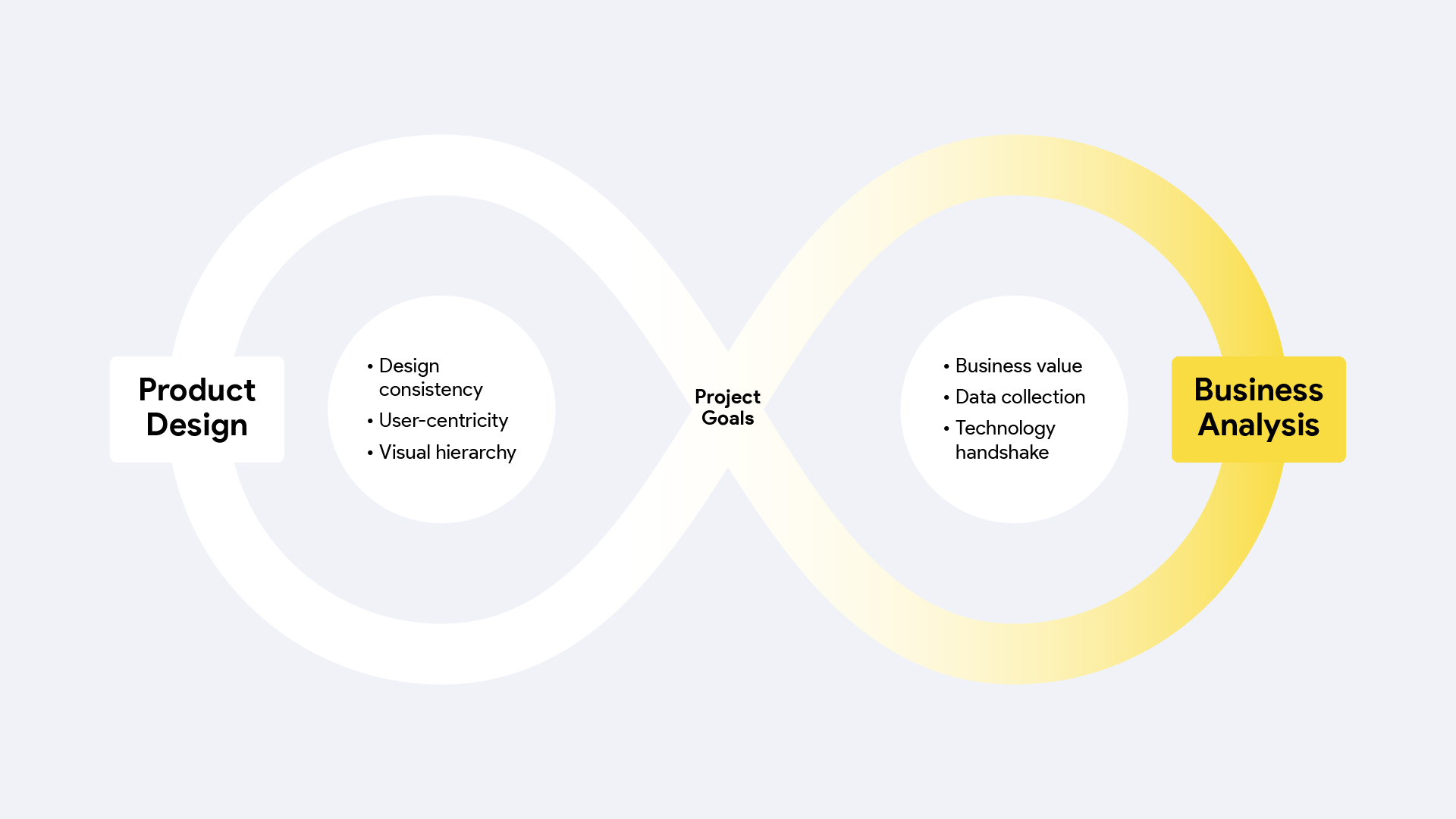
The pivotal role of business analysis in product design resides in its capacity to bridge the gap between business objectives and the actual development of a product that caters to user needs. Acting as a crucial link in the comprehensive product development lifecycle, business analysis ensures the resulting product aligns seamlessly with both business goals and user expectations.
How does it differ from marketing analytics? When people generally think of analytics, their minds often gravitate towards marketing analytics. However, product analytics constitutes an entirely different dimension. Marketers leverage historical data to comprehend customer behavior and tailor messages that resonate with them, drawing insights from past successes for replication. In contrast, product managers employ analytics to understand how customers interact with a product, identifying areas for enhancement and perpetually striving to optimize the user experience for long-term success.
At a high level, product analytics comes into play once a lead transforms into a user, concentrating on ensuring users derive pleasure from the product experience. Conversely, marketing analytics centers around the marketing process, aiming to acquire new users and drive sales.
Product analytics delves into customer experience, whereas marketing analytics focuses on demographics. With product analytics, you gain insights into user interactions with your product—the features they utilize, the time spent on each page, and areas of drop-off. On the other hand, marketing analytics empowers you to comprehend your customers’ origin, characteristics, and their responsiveness to various marketing channels.
By harnessing both types of analytics, a panoramic understanding of your audience emerges, guiding strategies to elevate the overall customer experience. Product analytics concentrates on elevating product engagement, while marketing analytics prioritizes increasing return on investment (ROI). Although both activities ultimately contribute to enhanced revenue, they do so through distinct avenues.
Product designers play a pivotal role in shaping designs that transcend aesthetics, influencing user satisfaction, engagement, and the overall user experience. By strategically incorporating business analysis metrics into their workflow, designers can refine their creations and meaningfully contribute to the success of the product.
1. Usability Testing Metrics:
• Task Success Rate: Percentage of successfully completed tasks by users.
• Error Rate: Number of errors users make while interacting with the product.
• Time on Task: Average time users spend to complete specific tasks.
2. User Satisfaction:
• Customer Satisfaction Score (CSAT): Direct feedback on user satisfaction.
• Net Promoter Score (NPS): Measures user likelihood to recommend the product.
3. User Engagement:
• Click-Through Rate (CTR): Percentage of users who click on a specific element or call-to-action.
• Bounce Rate: Percentage of users who navigate away after viewing a single page.
4. Design Impact Metrics:
• Conversion Rate: Measures the percentage of users who take a desired action, such as signing up or making a purchase.
• Feature Adoption: Track the adoption rate of new features or design changes.
• Retention Rate: Measures how well the design retains users over time.
5. Accessibility Metrics:
• Accessibility Compliance: Ensure that designs adhere to accessibility standards (e.g., WCAG) to reach a broader audience.
• Error Rates for Different User Groups: Assess the occurrence of errors among different user segments.
6. Collaboration and Workflow Metrics:
• Collaboration Efficiency: Measure the efficiency of collaboration between design and development teams.
• Iteration Time: Track the time it takes to implement design changes or updates.
7. User Research Metrics:
• User Feedback Analysis: Analyze qualitative feedback to identify design improvements.
• A/B Testing Results: Assess the performance of different design variations through A/B testing.
8. Design Operations Metrics:
• Design Velocity: Measure the speed at which the design team delivers new features or updates.
• Resource Utilization: Assess how efficiently design resources are utilized.
9. Overall Product Metrics:
• User Growth: Track the overall growth in the user base attributed to positive design changes.
• Customer Support Requests: Monitor if design changes impact the volume of customer support inquiries.
• Time to Value: Evaluate how quickly users realize the value of the product through design improvements.
10. User Journey Metrics:
• User Flow Analysis: Analyze user paths through the product to identify pain points or areas of improvement.
• Drop-off Rates: Identify where users abandon the product or specific features in their journey.
• Task Completion Rates: Measure the success rates for completing critical user tasks.
• Monitor in-app user behavior
• Establish and monitor custom events tailored to your product’s distinctive features and user interactions
• Categorize users according to specific attributes or behaviors
• Recognize the user journey and pinpoint drop-off points using funnel analysis
• Conduct A/B testing or, at the very least, provide the capability to integrate with A/B testing tools
• Two product analytics software solutions, Userpilot and Mixpanel, successfully meet these criteria.
References:
1-https://www.youtube.com/watch?v=Njys7BpNH6k&list=PLOCw5ug84-KC52yZrAz20CNpvU1EhMwtI&index=1&t=1930s
3- https://designlab.com/blog/measuring-product-metrics
4-https://www.mindsmapped.com/role-of-a-business-analyst-in-design
5-https://bootcamp.uxdesign.cc/business-analysis-and-service-design-d022f3584798

